What Is Epoxy? What Is It Used For?
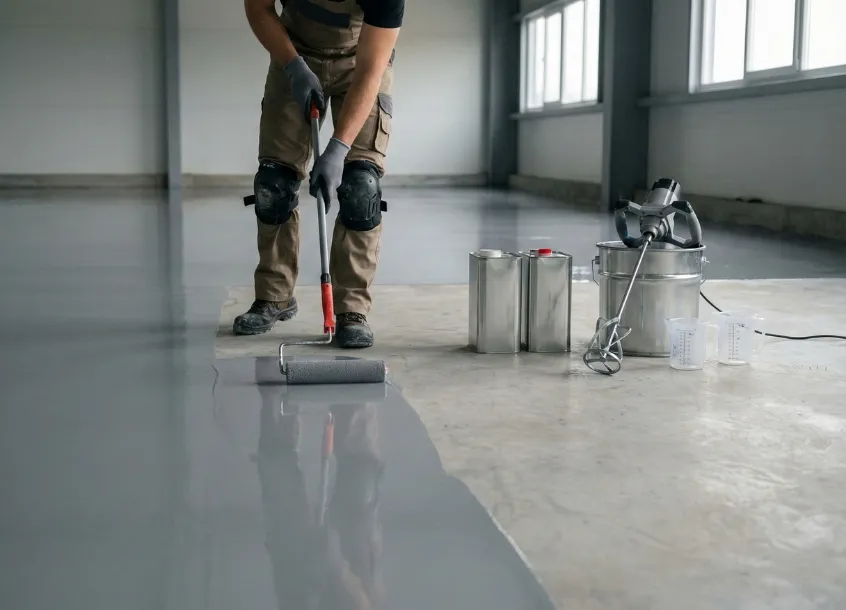
What Is Epoxy? What Is It Used For?
What Is Epoxy? What Is It Used For? Epoxy is one of the most reliable and widely used solutions among high-performance coating and bonding systems. Thanks to its chemical resistance, mechanical strength, and long service life, it has become a standard in both industrial and commercial buildings.
However, let’s be clear: Epoxy is not merely an aesthetic floor coating. When applied with the right product selection and proper substrate preparation, it does not only cover the floor; it actively works with the surface, making it durable and safe.
The critical point here is this: Epoxy is not a “cure-all” solution. When applied on the wrong surface, without solving moisture problems, or without proper substrate preparation, performance loss is inevitable. Therefore, epoxy systems should not be considered alone, but as part of a holistic building protection approach.
GET INFORMATION ABOUT EPOXY SOLUTIONS
What Is Epoxy?
Epoxy is a two-component system obtained by mixing epoxy resin and hardener in specific ratios. Once the curing process is complete, it turns into an extremely hard, durable, and chemically resistant structure.
When curing is complete, epoxy coating:
- Provides high compressive strength
- Shows resistance against chemicals
- Offers long-term performance against abrasion and impact
- Does not dust, crack, and preserves surface integrity
Thanks to these properties, epoxy is technically very different from conventional paint, concrete polish, or temporary floor coverings. Epoxy is not a simple coating that forms a film on the surface; it is a system that bonds mechanically and chemically to the substrate.
Key Technical Advantages of Epoxy
When choosing epoxy systems, it is not enough to consider only their “hardness”; their versatile technical advantages should also be taken into account.
Chemical Resistance
Epoxy coatings show high resistance against acids, oils, solvents, and industrial chemicals. This feature is especially critical for production facilities and technical areas.
Mechanical Strength
They provide long-term durability against mechanical effects such as heavy loads, forklift traffic, impact, and friction. Even under intensive use, they preserve surface integrity.
Hygiene and Cleanability
Thanks to their non-porous surface structure, they do not retain bacteria, dirt, or dust. For this reason, they are safely preferred in food facilities, laboratories, and healthcare buildings.
Long Service Life
When applied on a properly prepared substrate, epoxy coatings can be used for years without requiring maintenance. This significantly reduces the total cost of ownership.
Isoweir epoxy systems have been developed to provide these advantages at industrial standards with sustainable and stable performance.
Where Is Epoxy Used?
Epoxy coating systems are preferred in areas that require high performance and long service life. The main areas of use include:
- Industrial Floors: Production facilities, assembly lines
- Parking Garages: Areas exposed to vehicle traffic, oil, and fuel contact
- Factories and Warehouses: Sites where forklifts and pallet trucks are used
- Technical Areas: Machine rooms, boiler rooms, infrastructure rooms
- Water Tanks and Wet Areas: When applied together with proper waterproofing
Isoweir’s epoxy-based coating and insulation solutions are designed to maintain their performance even under heavy traffic and heavy loads.
GET INFORMATION ABOUT MOISTURE AND WATERPROOFING
Most Common Mistakes in Epoxy Applications
The most common problem encountered on-site is this: Epoxy is applied without proper substrate preparation.
The result is inevitable:
Blistering
Peeling from the surface
Cracks that occur over time
Performance loss due to moisture coming from the substrate
It must be said clearly: The problem is not epoxy itself, but an incorrectly designed system.
Every epoxy application carried out before solving moisture problems, before the concrete has cured sufficiently, or without proper surface preparation will fail in the short term.
Why Is the Combination of Epoxy and Waterproofing Essential?
The most common strategic mistake is seeing epoxy as a stand-alone solution. However, on surfaces exposed to moisture or active water, epoxy loses performance in the long term when applied alone.
The right approach is clear:
First, proper waterproofing is applied
Then, epoxy coating is applied
Epoxy coatings used together with Isoweir waterproofing systems maximize surface performance. Waterproofing protects the substrate, while epoxy makes the surface usable, hygienic, and durable.
Thanks to this dual system:
The service life of epoxy is extended
Surface performance remains stable
Maintenance and renovation costs are significantly reduced
Epoxy Is Not Just a Product, It Is a System
When properly designed and applied with the right substrate preparation, epoxy is a high-performance building investment. Randomly selected products and incomplete substrate solutions turn epoxy into a short-term coating.
Isoweir epoxy and waterproofing solutions protect the surface not only by considering today’s needs, but also by planning for the years ahead. The goal is not short-term fixes, but permanent and sustainable systems.
The clear conclusion is this: Epoxy must be evaluated not on its own, but together with the right waterproofing strategy.